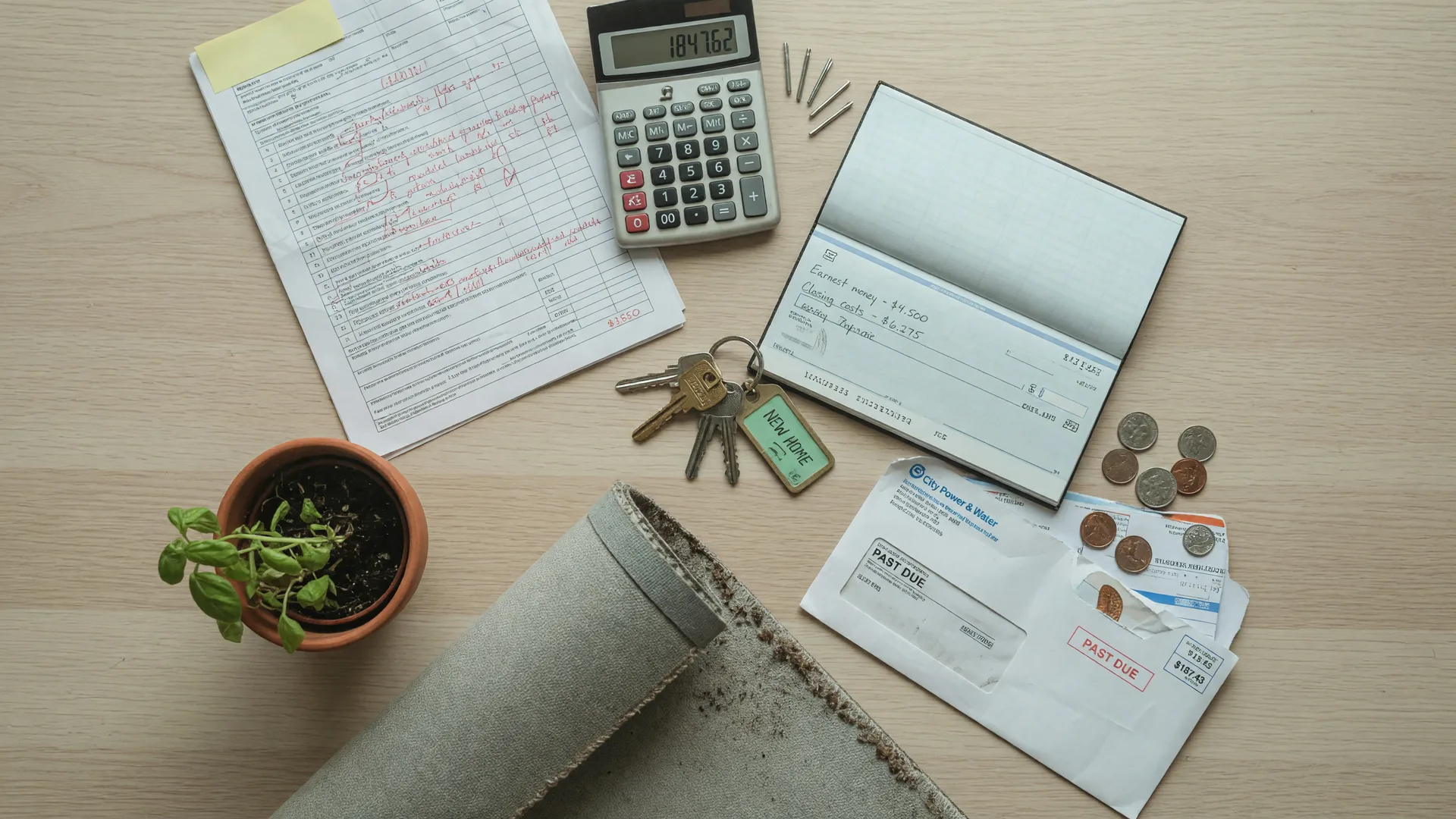

Everybody talks about the down payment. Very few people talk about everything else. Let me shine a light on the real costs of buying your first home so you walk in with your eyes wide open.
When I sit down with a first-time buyer, the first question is almost always the same: "How much do I need to save?" And they almost always mean the down payment. They've heard they need 3%, or 5%, or maybe 20%, and they've been working toward that number. But what nobody tells them is that the down payment is just the beginning.
I've seen buyers get all the way to the closing table and realize they're a few thousand dollars short because nobody warned them about the other costs. I don't want that to happen to you. So let me walk through every single cost that shows up when you buy your first home, beyond the down payment. I'll be straight with you about what to expect here in Northeast Ohio, and I'll help you plan for it.
Closing costs: the big one nobody explains
Closing costs are the fees and expenses you pay at the closing table, on top of your down payment. For most buyers, they run between 2% and 5% of the purchase price. So on a $250,000 home, you're looking at somewhere between $5,000 and $12,500 in closing costs.
Here's what that money actually pays for.
Appraisal fee. Your lender requires an appraisal to make sure the home is worth what you're borrowing. Expect to pay $400 to $600. This is non-negotiable, and you pay it even if the deal falls through.
Home inspection fee. This one is optional in the sense that you can waive an inspection, but I strongly advise against that. A good home inspection costs $300 to $500 and is the single best investment you'll make in the buying process. It tells you what you're actually getting into. I've seen inspections uncover foundation issues, roof damage, faulty wiring, and hidden mold. You want to know about those before you own the house, not after.
Title insurance and title search. The title company makes sure the seller actually owns the property and there are no liens, judgments, or ownership disputes hiding in the records. This usually runs $1,000 to $1,500 in Ohio. Title insurance protects you if something gets missed. It's a one-time fee paid at closing, and it covers you for as long as you own the home.
Loan origination fees. Some lenders charge a fee for processing your loan. It can be a flat fee or a percentage of the loan amount. It's worth asking about upfront so there are no surprises when you get the Closing Disclosure.
Prepaid items. Your lender will ask you to prepay some things at closing, including property taxes (if taxes are due soon), homeowner's insurance (the first year's premium is often paid at closing), and interest (the interest that accrues between closing day and your first mortgage payment). These aren't "fees" exactly, but they are cash you need to bring to the table.
Recording fees, transfer taxes, and courier fees. These are smaller line items, but they add up. Together they can be $200 to $500. The county charges a fee to record the deed. There may be a transfer tax depending on your municipality. And the title company might charge a courier fee to move documents around. Every dollar counts when you're budgeting.
Property taxes in Northeast Ohio
Ohios property taxes are not the highest in the country, but they're not the lowest either. And the way they work can be confusing if you've never owned a home before.
In Cuyahoga County, property tax rates vary by municipality, but you're typically looking at effective rates between 1.5% and 2.5% of the home's assessed value. In Lorain County, rates tend to be a bit lower, around 1.3% to 2%. Erie and Huron counties fall somewhere in the middle.
Let me give you a real example. On a $250,000 home in Avon, where our office is based, property taxes typically run around $4,000 to $5,000 per year. That's $333 to $416 per month. If you're coming from renting, that's a new monthly expense you need to factor into your budget.
The good news is that your lender typically collects property taxes as part of your monthly mortgage payment and holds them in an escrow account. So instead of writing a big check once or twice a year, you pay a little bit every month. It makes budgeting easier. But you still need to know what that number is going to be before you commit to a monthly payment.
One thing I always tell my buyers: look up the property tax history on any home you're serious about. The current owner's tax bill is based on the old assessed value. When you buy the home, the county may reassess it at the new sale price, and your taxes could go up. It doesn't always happen, but it can. I've seen buyers budget based on the seller's tax bill and get a surprise in year two.
Homeowner's insurance: what to expect
Your lender will require you to have homeowner's insurance. Period. You can't close without it. In Northeast Ohio, expect to pay $800 to $1,500 per year for a standard policy on a single-family home, depending on the home's value, age, and location.
Your homeowner's policy covers damage to the structure of your home, your personal belongings inside it, and liability if someone gets injured on your property. It does not cover flood damage or earthquake damage, and it may have limited coverage for sewer backups, which is something to ask about given the age of some homes in our area.
Shop around for insurance. Get three quotes. The rates vary significantly from one company to the next. And if you bundle your homeowner's policy with your auto insurance, most companies will give you a discount.
Maintenance costs: what renters never think about
This is the one that catches first-time buyers off guard more than anything else. When you rent, the landlord fixes the roof, the furnace, the water heater, the dishwasher. When you own, you are the landlord.
The rule of thumb in real estate is to budget 1% to 2% of your home's value per year for maintenance. On a $250,000 home, that's $2,500 to $5,000 per year. Some years you'll spend less. Some years the furnace goes out in January and you're writing a $4,000 check. It averages out.
Here are the big-ticket items every homeowner should plan for:
Roof replacement. An asphalt shingle roof lasts about 20 to 25 years in Ohio. Replacement runs $7,000 to $15,000 depending on the size and pitch of your roof. If the home you're buying has an older roof, factor that into your budget or negotiate with the seller.
HVAC system. A new furnace and central air unit runs $6,000 to $12,000. Expect them to last 15 to 20 years with regular maintenance. Change your filters. Get annual tune-ups. It extends the life of the equipment and saves you money in the long run.
Water heater. About 10 to 15 years. Replacement runs $800 to $1,500.
Appliances. Refrigerators, dishwashers, washers, dryers, ranges. They all have a finite lifespan. Budget for one major appliance replacement per year, about $500 to $1,500 depending on what goes.
And then there are the smaller things that add up. Lawn care. Snow removal. Leaf cleanup. Gutters. Paint. Caulking. Light bulbs. Air filters. A trip to the hardware store for that one thing you need. It's death by a thousand small expenses if you're not budgeting for it.
I'm not telling you this to scare you. I'm telling you this because I want you to succeed as a homeowner. And the first step to success is knowing what you're signing up for. If you budget for maintenance from day one, you won't be caught off guard when something breaks.
HOA fees: what they cover and what they don't
If the home you're buying is in a neighborhood with a homeowners association, you'll pay monthly or annual HOA dues. In Northeast Ohio, those typically range from $100 to $400 per month, though some luxury communities are higher.
HOA fees usually cover common area maintenance, snow removal in common areas, landscaping of shared spaces, and sometimes amenities like a pool, clubhouse, or fitness center. In some communities, the HOA fee also covers trash service and sewer. Read the fine print. Every HOA is different.
What HOA fees generally do not cover: repairs to your individual home. Your roof, your siding, your driveway, your plumbing. The HOA maintains the neighborhood's common spaces, not your personal property.
Before you buy in an HOA community, ask for the association's financials. You want to make sure they have adequate reserves for major repairs. A well-run HOA is a blessing. A poorly managed one can be a headache and a financial liability.
Moving costs and utility deposits
This is the stuff nobody thinks about until they're standing in their empty living room wondering how much the movers cost.
A local move in Northeast Ohio, hiring professional movers for a one-bedroom or two-bedroom home, typically runs $500 to $1,500. If you're moving yourself and renting a truck, you're looking at $100 to $300 for the truck rental plus gas, plus pizza for your friends who help. Either way, budget for it.
Then there are the utility deposits. If you've been renting, you probably already have utility accounts, but transferring or starting new service often comes with deposits or setup fees. Electric, gas, water, sewer, trash, internet, cable. Some companies charge a deposit if your credit history is thin. Budget $200 to $500 for utility-related startup costs.
And don't forget the little things. New locks for your doors. A lawnmower if you've never owned one. A snow shovel. A mailbox key. Window coverings. All the things you never needed as a renter that suddenly become your responsibility.
Putting it all together: what to save before you buy
Let me give you a realistic picture of what you need in the bank before you buy a $250,000 home, assuming a 5% down payment.
Down payment at 5%. $12,500.
Closing costs at 3%. $7,500.
Moving and setup. $2,000.
Emergency fund for maintenance. $3,000 to $5,000.
Total: roughly $25,000 to $27,000.
I know that's a big number. But I'd rather you know it now than discover it at the closing table. And there are ways to reduce some of these costs. Some closing costs can be negotiated with the seller. Some lenders offer programs with reduced closing costs in exchange for a slightly higher rate. Down payment assistance programs in Ohio can help with the upfront cash.
The key is to plan ahead. If you know what you're working toward, you can save intentionally and avoid the last-minute scramble that I've seen derail so many otherwise-ready buyers.
The Reverse Selling approach to your first home
Here's something I believe with my whole heart. My job is not to sell you a house. My job is to help you buy the right home with confidence. That means being honest about the costs, the risks, and the process before you ever step foot in a showing.
I call it Reverse Selling. I don't push. I educate. I lay out the real numbers, the real costs, and the real trade-offs, and then I help you make a decision that's right for you. If that means waiting another six months to save more, I'll tell you that. If it means looking at a different price range, I'll tell you that too.
The first-time buyers who work with me tell me they feel prepared, not pressured. They know what to expect at every step. And when they get to the closing table, there are no surprises. That's how it should be.
Buying your first home is one of the biggest financial decisions you will ever make. You deserve someone who will walk you through every cost, every document, and every question with patience and honesty.
That's what The Pinnacle Post Team is built on. Accountable. Humble. Gritty. Honest. We do the work so you don't have to wonder if you're making the right call.
I've put together a First-Time Homebuyer Guide that walks through the entire process from pre-approval to closing, including a detailed breakdown of every cost you'll encounter. It's written in plain English, and it covers everything you need to know before you start looking at homes.
Or if you want to talk through your specific situation, reach out to me directly. I'll be straight with you about where you stand and what your next steps should be. No pressure. No sales pitch. Just honest guidance from someone who's been helping first-time buyers in Northeast Ohio for a long time.
Published by Gary L. Post, The Pinnacle Post Team at RE/MAX Crossroads.