
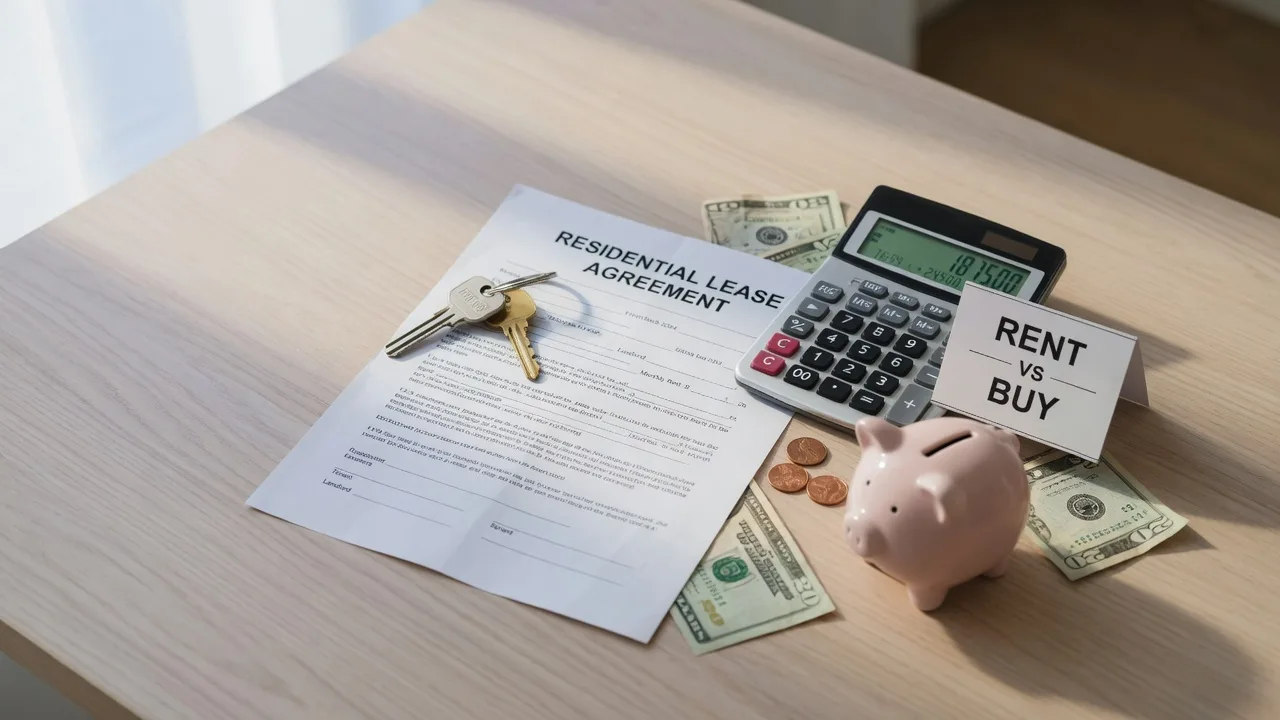

I get asked this question more than almost any other. Should I keep renting, or am I ready to buy? And the honest answer is, it depends. But not for the reasons you might think.
Let me start with something I tell every client who sits down across from me. I am not here to talk you into buying a home. I am here to help you make the right decision for your life. And sometimes that means telling you it's not the right time. But more often than not, it means showing you that you're closer to ready than you think.
The rent versus buy question is emotional. It's financial. It's practical. And it's personal. Your parents, your coworkers, and your friends all have opinions. But the only person who needs to be convinced is the one staring at the ceiling at 2 AM wondering if you're making the right call.
So let me walk through this the way I would if you were sitting in my office right now. No sales pitch. Just the real math, the honest signs, and the questions you should be asking yourself.
The real math behind renting vs. buying
Let's start with the simplest version of the math. When you rent, you write a check every month, and at the end of the month, the money is gone. You got a roof over your head, which is worth something, but you own nothing. The landlord's mortgage gets paid. The property appreciates. And you start over next month.
When you buy, you write a check every month too. But part of that check goes toward principal. That's money that comes back to you when you sell. It's yours. You're building equity. Over time, your monthly payment stays relatively stable while rents go up almost every single year. And your home, historically, appreciates in value.
I'm not going to claim that buying is always the answer. It's not. But I want you to understand the trade-off clearly. Every year you rent, you pay someone else's mortgage. Every year you own, you pay your own. And that difference adds up fast.
Let's say you're paying $1,500 a month in rent. Over five years, that's $90,000. That's $90,000 you will never see again. If you had bought a home with a $1,500 monthly payment, a good chunk of that would have gone toward principal. You'd have built equity, maybe $20,000 to $30,000 depending on the loan terms and appreciation. And at the end of five years, you'd have something to show for it.
Now, I know there are costs to buying. Closing costs, maintenance, property taxes, insurance. I'm not ignoring those. But the question is not whether buying costs money. It's whether the long-term wealth-building potential outweighs the short-term costs. For most people, in most markets, it does.
Signs you're ready to make the jump
So how do you know if you're ready? Here are the signs I look for when I'm talking with a prospective buyer. You don't have to check every box, but the more of these that fit, the more confident I feel about your timeline.
You have stable income. I don't mean you need to be in the same job for ten years. But you should have a steady employment history and a clear picture of what you'll be earning in the year ahead. Lenders want to see two years of consistent income, preferably in the same field. If you just started a new job, that's fine. If you're a 1099 contractor, we'll need two years of tax returns. But if your income is solid and predictable, you're in good shape.
Your debt is manageable. Lenders look at your debt-to-income ratio. That's the percentage of your gross monthly income that goes toward debt payments including your future mortgage. Most conventional loans allow up to 43% to 50% DTI, but the sweet spot is under 36%. If your car payment, student loans, and credit cards are eating up too much of your income, we may need to address that first. But don't assume a little debt disqualifies you. I've worked with plenty of buyers who had student loans and still qualified comfortably.
You plan to stay put for a while. Buying a home comes with transaction costs. You pay closing costs on the way in, and you'll pay a commission when you sell. If you're planning to move again in two years, renting might make more sense. But if you see yourself in the same city, the same area, the same house for three to five years or more, buying starts to look a lot better.
You're tired of renting. This is not a financial sign, but it matters. If you're frustrated with rent increases, with not being able to paint a wall or hang a picture, with a landlord who doesn't respond to maintenance requests, that frustration is real. It's worth something. Buying a home gives you control. You decide what gets fixed, what gets painted, and what stays. That peace of mind has value.
What monthly payment can you actually afford?
This is where the rubber meets the road. Forget what the bank says you qualify for for a second. The real question is, what are you comfortable paying?
A good rule of thumb is that your total housing cost, including principal, interest, taxes, and insurance, should not exceed 28% to 31% of your gross monthly income. But that's a lender guideline. Your comfort level may be different. If you're currently paying $1,400 in rent, a $1,600 mortgage payment might feel manageable even if it's slightly over 28%. On the other hand, if you're used to a $900 rent payment, jumping to $1,800 might feel like a shock even if the numbers say you can afford it.
Here's what I recommend. Sit down with your actual expenses for the last three months. Not what you think you spend. What you actually spent. Then add a realistic housing payment on top. If you can still save, still eat out occasionally, still put money into an emergency fund, you're probably in good shape.
I also tell clients to budget for maintenance. Plan on setting aside 1% to 2% of the home's value each year for repairs and upkeep. On a $250,000 home, that's $2,500 to $5,000 a year. Some years you'll spend less. Some years a water heater will fail and you'll spend it all at once. But if you're prepared for it, it won't throw you into a panic.
And one more thing. Your monthly payment is not a trap. It's a trade. You trade a payment that keeps going up (rent) for a payment that stays relatively flat (a fixed-rate mortgage). Over time, inflation makes your mortgage payment feel smaller. Your rent payment only feels bigger.
Common fears first-time buyers have and why they're usually overblown
I've been doing this long enough to hear the same fears over and over. Let me address a few of them directly.
"I'm afraid I'll make a mistake." You will. Everyone does. Not a catastrophic mistake, but you'll look back and wish you had done something differently. Maybe you wish you painted the living room before you moved in. Maybe you wish you had offered $5,000 less. But that's not a disaster. That's just life. And the truth is, the biggest mistake I see people make is not buying at all. They wait for perfect conditions, and perfect conditions never come.
"I'm afraid I can't afford it." I understand this fear. But I also know that most people overestimate what they need and underestimate what they can afford. A good lender will give you a pre-approval that tells you exactly what your payment would be. Then you can decide. Not based on a guess. Based on a number. And if that number doesn't work, we adjust. There are always options.
"I'm afraid of the market." The market is always doing something. Prices are up. Prices are down. Interest rates are high. Interest rates are low. There is never a perfect time to buy. But there is a perfect time for you. And that time is when you're ready, when the numbers work, and when you find a home that fits your life. I cannot predict where interest rates will be in two years. Neither can anyone else. What I can tell you is that if you buy now, you lock in today's rate. If rates drop later, you can refinance. If you wait and rates go up, you've lost the opportunity.
"I'm afraid of maintenance." I get it. Nobody wants to wake up to a flooded basement or a broken furnace. But here's the thing. Most homes are not falling apart. A good home inspection will tell you exactly what you're walking into. And if you budget for repairs, the maintenance isn't a crisis. It's just part of homeownership. And honestly, there's something satisfying about fixing your own stuff. It's your house. You get to decide how it's taken care of.
"I'm afraid I'll feel trapped." This is a real one. A home is the biggest purchase most people will ever make, and the idea of being tied to a 30-year commitment is intimidating. But the reality is, you're not locked in for 30 years. The average homeowner stays in their home about 7 to 10 years. If your circumstances change, you can sell. You can rent it out. You can refinance. You have options. A home is not a cage. It's an asset.
The hidden cost of waiting
This is the part I want you to pay closest attention to, because it's the one most people overlook. There is a real, measurable cost to waiting. It's not just the rent you'll pay while you sit on the sidelines. It's the equity you won't build. It's the appreciation you won't capture. It's the interest rate you might miss.
Let me give you a concrete example. Say you're looking at a $250,000 home. Today, interest rates are at, let's say, 6.5%. Your monthly payment on a 30-year fixed with 5% down would be about $1,800 including taxes and insurance. If you wait two years and rates go to 7.5%, your payment on that same home jumps to about $2,000. That's $200 more per month, $2,400 more per year, $72,000 more over the life of the loan.
And if home prices go up 5% in those two years? That same home is now $262,500. You're paying more for the house, and you're paying more in interest. The cost of waiting in this scenario is tens of thousands of dollars.
Now, I'm not saying this to scare you into buying something you can't afford. I'm saying it so you understand the full picture. The decision to wait is not neutral. It has a cost. Sometimes that cost is worth it. If you need more time to save, to improve your credit, to get your finances in order, then waiting is the right move. But if you're waiting because you're scared, and the numbers already work, the waiting is costing you money.
I started in real estate at 40 years old with no degree and no safety net. I know what it feels like to look at a big number and think you'll never get there. But I also know that the only way to get there is to take the first step. And the first step is not making an offer on a house. The first step is sitting down with someone who can show you the real numbers and tell you whether you're ready or not.
The bottom line
Renting is not throwing money away. It's paying for a place to live. But buying is building something. It's building equity, stability, and a future. And the gap between what you think you need and what you actually need is usually smaller than you imagine.
If you're comfortable with your income, your debt is manageable, and you plan to stay put for a few years, you're probably more ready than you think. The next step is a real conversation about your numbers. Not a general advice column. Your specific income, your specific savings, your specific goals.
That's what I do. I educate. I lay out the options. I tell you what I'd do if I were in your shoes. And then I support whatever decision you make.
// CTAI've put together two free guides that answer the next set of questions you're probably asking. The First-Time Homebuyer Guide covers the entire process from pre-approval to closing, written in plain English. And the Fall Buyer's Guide breaks down everything you need to know about buying this season.
Or if you want to talk through where you stand, reach out to me directly. I'll give you the honest truth about whether you're ready to buy, and what your next steps should be if you are.
Published by Gary L. Post, The Pinnacle Post Team at RE/MAX Crossroads.