
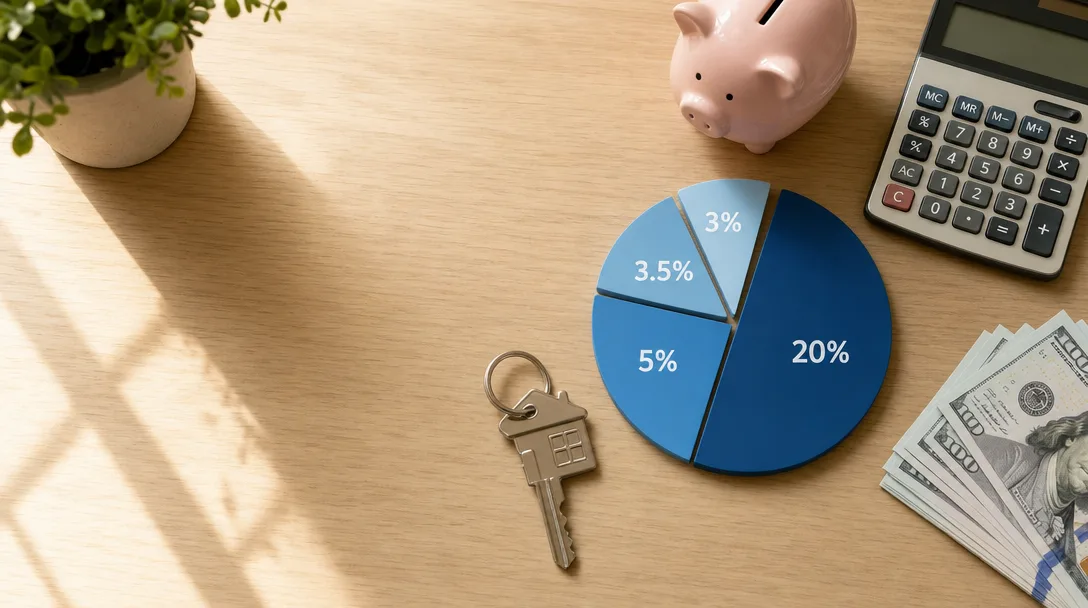

If you've been putting off buying a home because you think you need 20% down, I've got some good news. That number is a myth for most buyers.
I hear it all the time. Someone sits down across from me and says, "Gary, I've been saving, but I'm only at about 8% of what I'd need for a down payment. I figure I've got another couple years." And I have to stop them right there, because the assumption they're working off is wrong. They think they need 20%. And in most cases, they don't.
That 20% number got stuck in our collective heads somewhere along the way. Maybe your parents bought their first home in the 80s and put 20% down because that's what everyone did. Maybe a friend told you that anything less and you're throwing money away on PMI. Maybe you just assumed it, because it's the one number everyone seems to mention.
Whatever the source, let me clear this up. The 20% rule is not a requirement. It's a threshold that waives private mortgage insurance on a conventional loan. That's it. And for a lot of buyers, the math actually works in their favor putting down less and getting into a home sooner.
Let me walk you through what's actually possible, because the options might change the way you think about your timeline.
The three most common low-down-payment loans
Let's start with the basics. There are three major loan programs that let you put down way less than 20%, and each one works a little differently.
A conventional loan with 3% down is available through Fannie Mae's HomeReady and Freddie Mac's HomeOne programs. These are designed specifically for first-time buyers and low-to-moderate income borrowers. You can put down as little as 3% on a fixed-rate mortgage. That means on a $250,000 home, your down payment is $7,500. Not $50,000.
An FHA loan, backed by the Federal Housing Administration, requires just 3.5% down with a credit score of 580 or higher. FHA loans are the most popular option for first-time buyers in this country, and for good reason. They're accessible, the credit requirements are forgiving, and the down payment is manageable. On that same $250,000 home, we're talking about $8,750.
And then there's the 5% down conventional loan. Some lenders offer conventional loans starting at 5% down if your credit profile is a little stronger or if the 3% programs don't quite fit. It's a small step up that can give you slightly better terms.
The point is, none of these numbers are 20%. And all of them are realistic for buyers with steady income and decent credit.
Zero down: VA and USDA loans
Now let's talk about the two programs that take the idea of a down payment and essentially remove it from the equation.
VA loans are available to veterans, active duty service members, and eligible surviving spouses. The Department of Veterans Affairs does not require a down payment. Zero. Not 3%. Not 5%. Zero. As long as you meet the lender's credit and income requirements, you can finance 100% of the purchase price.
I work with veteran buyers pretty regularly, and I can't tell you how many of them had no idea this benefit was available to them. They had been renting for years, assuming they needed to save up a down payment, when in reality they could have been homeowners from day one. If you served, look into this. Seriously. It's one of the best benefits you've earned.
USDA loans, backed by the U.S. Department of Agriculture, also offer zero-down financing for homes in eligible rural and suburban areas. A lot of people hear "USDA" and think farmland, but you'd be surprised how many communities in western Cuyahoga, Lorain, Erie, and Huron counties qualify. The income limits are reasonable, and the interest rates are competitive. If you're buying outside of a major city center, it's worth checking whether USDA is an option.
What about PMI? The thing everyone worries about
I know what you're thinking. "If I put down less than 20%, I have to pay PMI, and that's just throwing money away." I hear this objection more than almost any other. And I get it. Nobody wants to pay for something they don't feel like they're getting value from.
But let's talk about what PMI actually is and what it costs, because the reality is not as scary as the reputation.
PMI stands for private mortgage insurance. It protects the lender in case you default on the loan. That's the simple version. And yes, you pay for it. But on a conventional loan with 5% down, PMI typically runs somewhere between $30 and $70 per month for every $100,000 borrowed. On a $250,000 loan, we're talking about $75 to $175 a month. That's not nothing. But compare it to the alternative.
If you wait three more years to save up 20% so you can avoid PMI, you're paying rent that whole time. If your rent is $1,400 a month, that's $50,400 over three years. And at the end of those three years, you still don't own anything. Meanwhile, home prices may have gone up, and interest rates may have shifted.
Or you buy now with 5% down, pay $100 a month in PMI for roughly 7 to 10 years (or less, if your home appreciates), and you've been building equity the whole time. You're paying your own mortgage instead of your landlord's.
Here's the other thing. On an FHA loan, mortgage insurance (MIP) works a little differently. You pay an upfront premium (1.75% of the loan amount, which can be rolled into the loan) and then an annual premium of 0.55% to 0.85% depending on your down payment and loan term. That annual premium is split into monthly payments. And unlike conventional PMI, FHA MIP stays for the life of the loan if you put down less than 10%. That's worth knowing. But the trade-off is a much lower barrier to entry.
The key takeaway? PMI is not the enemy. The enemy is staying on the sidelines out of fear of a cost you haven't actually run the numbers on. A good lender can give you a precise PMI quote before you ever make an offer. Then you can decide if it's worth it. More often than not, the math favors buying now.
When does PMI go away?
On a conventional loan, PMI automatically terminates when your loan balance reaches 78% of the original value of your home. You can also request cancellation at 80% LTV (loan to value), provided you're current on payments and meet certain conditions. If your home appreciates faster than expected, you may reach that threshold even sooner.
On an FHA loan with less than 10% down, MIP stays for the life of the loan. If you put down 10% or more, it drops off after 11 years. That's one reason I sometimes steer buyers toward conventional loans when they can qualify, even if the down payment is the same.
But none of this should scare you out of buying. It's just information you need to make an informed choice. And that's what I'm here for.
Down payment assistance programs in Ohio
Here's something a lot of people don't know. There is money available to help you buy a home. Real money. Grants and low-interest loans designed specifically for Ohio homebuyers.
The Ohio Housing Finance Agency (OHFA) offers several programs that can make a huge difference. Their Grants for Grads program provides up to 5% of the loan amount for down payment assistance to recent college graduates. Their Ohio Heroes program offers assistance to veterans, active duty military, teachers, police officers, firefighters, and healthcare workers. And their standard first-time homebuyer program provides 30-year fixed-rate mortgages with down payment assistance up to $15,000.
These programs are real. They exist. And they are specifically designed to help people like you buy a home in Ohio. I've had clients use OHFA assistance to cover their entire down payment and a big chunk of their closing costs. They walked into closing having put almost nothing of their own money down — and they walked out homeowners.
There are also local programs in Cuyahoga, Lorain, Erie, and Huron counties that offer additional assistance. The best way to find out what you qualify for is to have a conversation with a lender who knows Ohio programs inside and out. And I can connect you with one.
The real question is not how much you need. It's whether you're ready to start the conversation.
I didn't go to college. I didn't have a trust fund. I started in real estate at 40 years old with nothing but a willingness to work hard and figure things out as I went. I know what it feels like to look at a number and think, "I'm never going to get there." But I also know that the first step is getting the right information from someone who's got no reason to feed you a line.
That's what I do. I educate my clients. I lay out the options. I tell them what's possible, what the trade-offs are, and what I'd do if I were in their shoes. Then I let them decide. No pressure. No sales pitch. Just the facts.
If you've been asking yourself how much you really need for a down payment, the answer is probably less than you think. But you won't know for sure until you talk to someone who can look at your specific situation and show you the numbers.
That someone could be me. Or it could be a lender I trust. Either way, the first step is picking up the phone or sending an email.
I've put together a Fall Buyer's Guide that covers down payments, credit scores, closing costs, and everything else you need to know about buying a home this season. It's free, it's honest, and it's written for real people, not industry insiders.
Or if you want to talk through your specific situation, reach out to me directly. I'll give it to you straight — whether you're ready now or not yet.
Published by Gary L. Post, The Pinnacle Post Team at RE/MAX Crossroads.